
Max Zeltsar
The sun has just risen over the Bwindi Impenetrable Forest in Uganda. The air is cool and still. The silhouette of the verdant rainforest is emerging in the early morning light. Alongside a handful of other tourists, I stand in front of four rangers from the Uganda Wildlife Authority, listening intently as they brief us on the plan for the day. As closely as I am listening, it is impossible to stop my mind from wandering off into the trees behind them. My hands are shaking a bit and the goosebumps along my arms tell me that it is from excitement—not the cold. My anticipation for this day, for this moment, has been building over the past several months. I have traveled some 7,000 miles with the hopes of seeing one of the world’s most endangered animals, the mountain gorilla.
As we set off into the forest, the scenery takes my breath away. I have been lucky enough to witness the raging waterfalls of Iceland and the regal sequoia forests of California, but this landscape is something else entirely. Massive trees with sprawling canopies loom over rolling hills. Mist still clings to the valleys as the sun starts to rise higher into the sky. Overcome with awe, I momentarily forget that I came here to see mountain gorillas. I also forget to watch where I am walking and am jolted back to reality as I stumble across a root. Gathering my footing, I remember that somewhere within this otherworldly landscape, a family of mountain gorillas is waking up for the day.
The rangers lead us along an overgrown path, deeper into the jungle. As they round the corner ahead of us, the first ranger freezes so suddenly that the other three almost crash into him. The tour group and I all glance around excitedly as we too stop. We all seem to have come to the same conclusion: we must be getting close to the gorillas. A couple of the tourists start to pull out their cameras and I decide that I should do the same.
I am just finishing attaching my lens when the lead ranger points to a large tree across the valley from where we are standing. He says that he has seen a couple of gorillas climb up the tree. I look as hard as I can, but even with my ability to use my camera as a telescope, I can see nothing. No one else can either. Collectively we turn around, ready to continue walking in hopes of getting a better view. As we are about to continue onwards, we hear the swishing of leaves and turn around just in time to see one of the branches on the tree dip. I can barely make out the silhouette of a gorilla before it swings back into the canopy, but this quick glance has left quite an impression.
The wonderment of the group is almost as impressive to witness as the gorilla itself. An excited murmur washes across our group as we process what we have just seen. The rangers tell us that we are going to continue onwards so that we can get closer but most of the group seems hesitant to move a muscle, afraid that if we leave this spot, the magic of the moment may leave too.
Another half an hour’s worth of hiking goes by and the rangers stop again, this time not so suddenly. They turn to us and announce that we are now very close to the gorillas. They give us rules for how we should behave around them: don’t move too suddenly, don’t get too close, don’t wave at them, and so on. This time my mind is not wandering. As excited as I am, I have no intention of startling, angering, or annoying a 300-pound wild animal with superhuman strength. The briefing ends and we take a minute to prepare ourselves to sit with the family of gorillas.
As excited as I am, I have no intention of startling, angering, or annoying a 300-pound wild animal with superhuman strength.
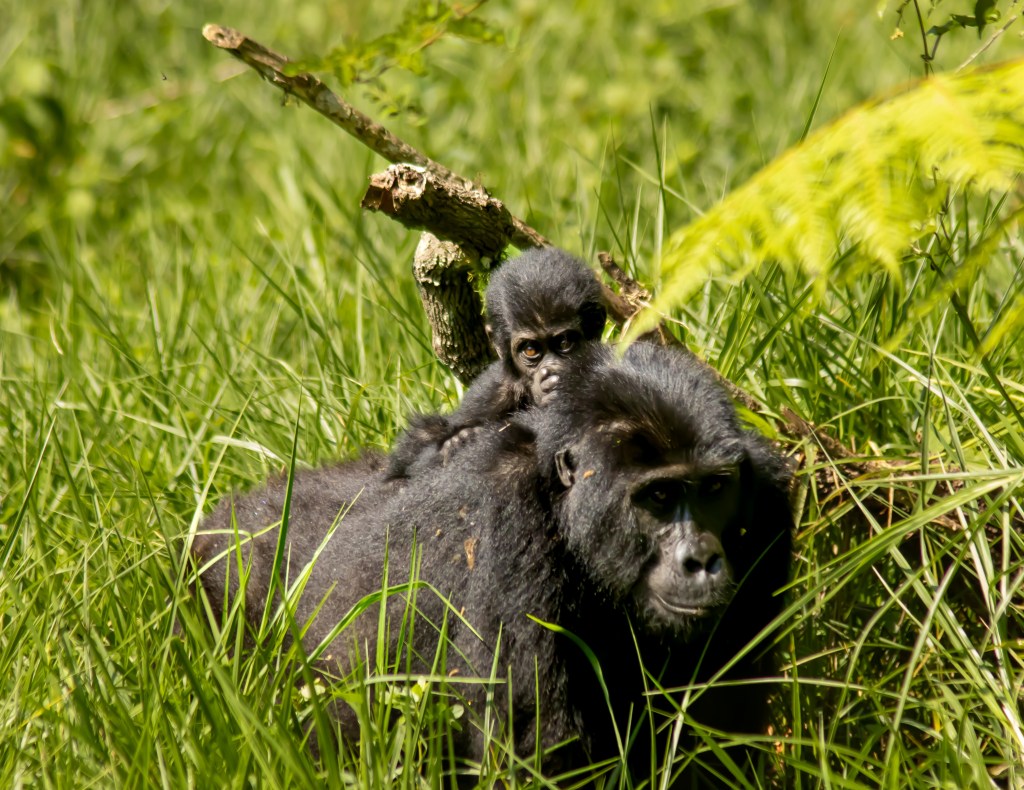
The rangers have us follow them 15 more feet through the undergrowth. The lead ranger pushes some brush out of the way and nudges his head silently forward urging me to walk ahead. As I step past the ranger I hear a loud snap as a branch breaks somewhere to my right. I turn my head slowly to follow the sound and there, no more than 30 feet in front of me, is the family of gorillas that I had traveled all this way to see.
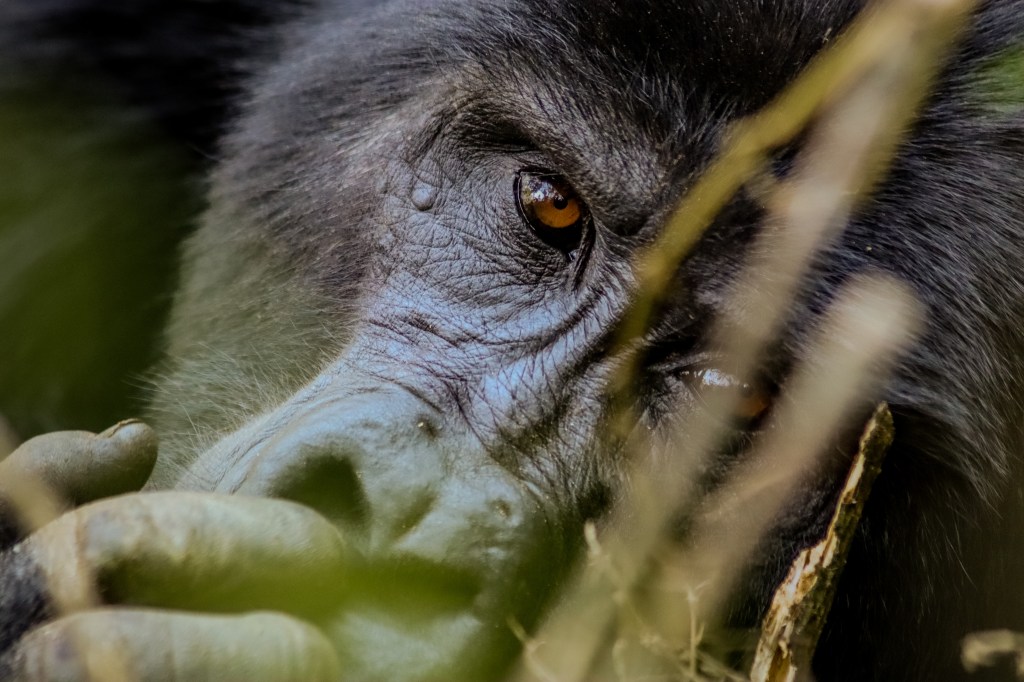
As I looked around at the gorillas, I glanced briefly below at one young adult lying just downhill from me. The rangers had warned us not to make eye contact with the gorillas since it could be taken as a sign of aggression, but for a brief moment, both of us stopped and stared at each other. I have come face to face with many different animals, and have seen all sorts of intelligence, curiosity, and emotion reflected in their eyes, but what I saw in this moment was something entirely different. These eyes were familiar, almost human. Photos and words don’t quite do justice to the fleeting moment of holding eye contact with a gorilla, but it is the closest I have ever felt to an animal. In that moment there was a real, tangible, recognition of the other being in a way I have only ever experienced with humans.
The eye contact lasted a second at most but I have spent hours replaying the memory in my head since. It has not lost any of its power or vividness, but in all my time spent reminiscing about my encounter with the gorillas of Bwindi Impenetrable Forest, there is another thought that sits alongside my memories. Something is missing from the experience I have recounted, a set of details that I cannot ignore.
Around 40 years ago, that missing element was almost the gorillas themselves. Over the previous century, their populations had dwindled dangerously low as a result of poaching, habitat loss, and human-wildlife conflict (largely due to British colonization). By the 1980s, it was estimated that their populations were as low as just 250 individuals. One of humankind’s closest living relatives was on the verge of extinction, largely due to our own impact.
Fortunately, scientists who were monitoring the mountain gorilla populations intervened just in time. Local and foreign scientists and policymakers made a concerted effort to protect the remaining individuals in a remarkable feat of conservation. The countries of Uganda, Rwanda, and the Democratic Republic of the Congo worked to designate protected areas and resources to save the mountain gorilla as a species. Bwindi Impenetrable Forest is one of those protected areas.
The effort that was made has not been in vain. Mountain gorilla populations have almost doubled as a result of these conservation efforts. Ongoing intensive monitoring helps to ensure that this trajectory continues. While their survival is not guaranteed, the outlook for them is more promising than ever.
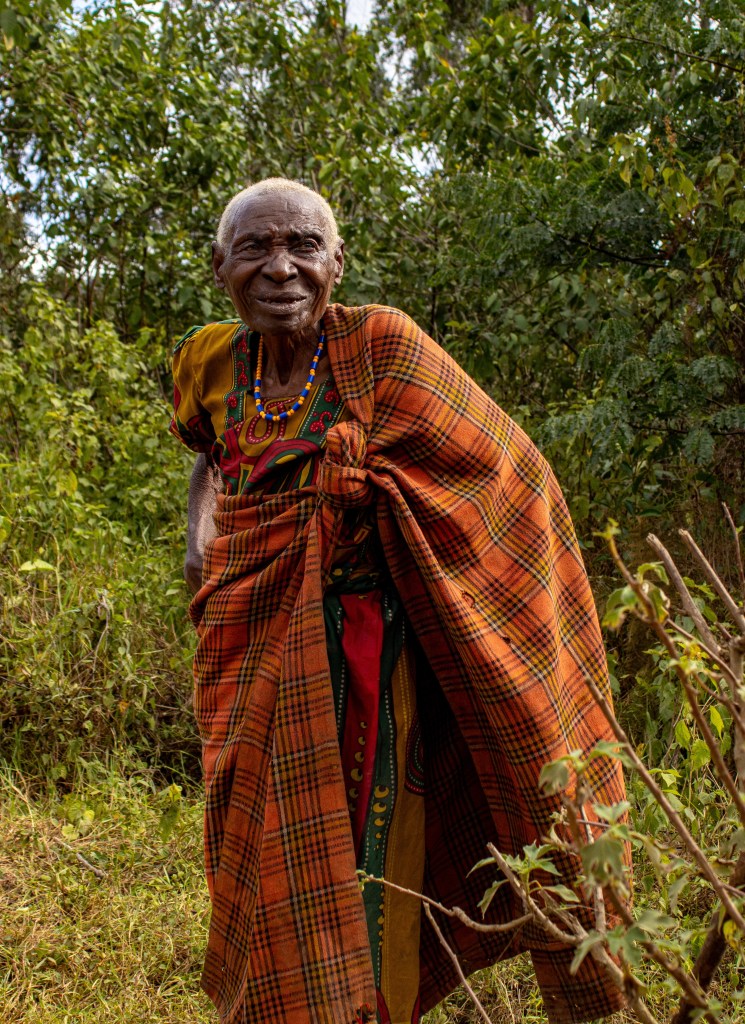
There is, however, another fundamental element of this landscape that is absent. Bwindi Impenetrable Forest, where I was lucky enough to encounter the mountain gorillas, was not designated as protected land until 1991. Before that, the rainforests were home to a group of people known as the Batwa. As a part of establishing the conservation area, the Ugandan government forcibly evicted the Batwa people from their homeland. To do so, foreign conservationists and the Ugandan government wrongly villainized the Batwa people, claiming that they were the cause of the gorilla population decline. While these claims were not rooted in fact, they were used as justification for excluding the Batwa people from their ancestral home. In the three decades since their eviction, the Batwa people have been provided little aid from the government and are largely ignored by nongovernmental organizations and public media. Mountain gorilla populations in Bwindi Impenetrable Forest are indeed recovering but at the expense of the Batwa people.

The story of the Batwa people cannot be separated from the story of mountain gorilla conservation. The two histories are and always have been, intertwined. The events that the Batwa people have been forced to endure should be acknowledged, reported, and reconciled. A handful of sources from tourist companies, news articles, and scientific reports discuss the problematic nature of the existence of Bwindi Impenetrable Forest, but these are frequently buried under countless travel articles from sources like National Geographic and UNESCO that fail to acknowledge the existence of the Batwa people. In the scramble to put gorillas in the spotlight, the Batwa people continue to be largely ignored and marginalized. Most tourists arrive at Bwindi Impenetrable Forest knowing little to none about the Batwa people, and many of them leave the same way. Even a brief and unofficial poll of my group and a handful of other tourists proved that only one of the roughly twenty people I was speaking with had ever heard of the Batwa people.
The erasure of the Batwa people’s story is unacceptable. So long as this continues to occur, the recovery of mountain gorilla populations cannot be perceived as a successful conservation effort as it is so often portrayed. This story is one example of a larger pattern of a colonial approach known as “fortress conservation”, where natural spaces are partitioned from human activity as an alleged way of protecting them. Conservation cannot be predicated on the idea of isolating humans from wildlife. Ultimately, this approach to conservation, which unjustly traded the future of the Batwa for the future of the gorillas, is unsustainable and unethical. This method of so-called conservation polarizes the relationship between the Batwa people and mountain gorillas. It fosters the belief that for one to succeed the other must be removed.
This philosophy is fundamentally flawed. Both the Batwa people and mountain gorillas belong in the Bwindi Impenetrable Forest. One does not have to leave for the other to thrive or even survive. For mountain gorilla conservation to be truly successful and self-sustaining, the Batwa people must be included. The forced exclusion from Bwindi Impenetrable Forest must end and reconciliation for the decades of mistreatment that the Batwa people were forced to undergo must occur in a manner that they agree upon. This responsibility falls on tourists and public media as well. The complete history of Bwindi Impenetrable Forest should be common knowledge for every person who travels there. Lastly, the approach to conservation must shift to foster coexistence between the Batwa people and mountain gorillas and develop sustainable practices that allow both to thrive. It is only then that this can progress forward as a successful conservation story.
As a foreign tourist to this issue, this is an incredibly difficult story to grapple with. As a conservation biologist, I desperately want to work towards more sustainable ways of saving biodiversity. I want to do everything in my power, including sharing my experiences, to advocate for and effect positive change. At the same time, the experience of the Batwa people is not my own, and I have only been a brief visitor to these events. It is important to remember that the story of the Batwa people is representative of a larger issue in conservation practice. I share this experience both to bring awareness to the problematic history of mountain gorilla conservation as well as to reflect on what it means to conserve wildlife in a just and sustainable manner. Doing so is no easy task and does not have one concrete answer. I hope that the story of the Batwa people can help to inspire thought about how to work towards a more equitable approach to addressing environmental issues; both in Bwindi Impenetrable Forest and beyond.
Getting to spend time with mountain gorillas in their natural habitat was one of the most memorable experiences that I have ever had. The gorillas, like all wildlife, are deserving of conservation, attention, and admiration. I hope that their populations continue to recover and that people continue to have the opportunity to observe them in the Bwindi Impenetrable Forest. The ability to engage with the natural world firsthand is one of the most powerful tools that we have for developing support for conservation and raising awareness of the perilous state of biodiversity globally. That being said, I hope that nobody gets to see the gorillas the way that I did. Instead, I hope that people see them in a new way — a way where the Batwa people have been compensated for the removal that they were forced to experience. A way where the history of the Batwa people is intertwined with the story of gorilla conservation. A way where both the mountain gorillas and the Batwa people thrive.

 Middlebury Geographic
Leave a comment