Max Chalfin-Jacobs

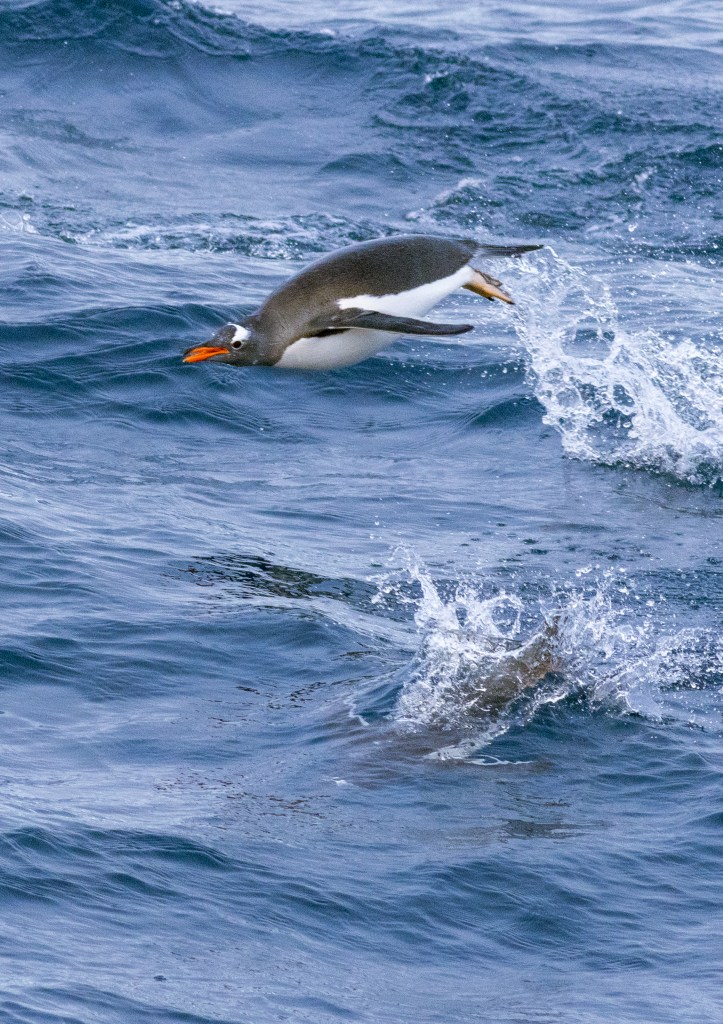
As I stepped up to the bridge of the RV Laurence M. Gould, my view was filled with immense snow-covered mountains erupting out of a tumultuous sea, a piercing view after four days with no sight of land. That time on the water had been a vessel for excitement and preparation for the work to come, but all that seemed insignificant in the shadow of the island of South Georgia. Frigid Antarctic waves crashed into the ship’s bow, leaving behind an icy mist that shimmered in front of the morning sun. Suddenly, about two kilometers off of the bow, a spray of water vapor filled the air, climbing twenty feet before a fin whale’s slate gray back emerged between wave crests. The awe that came with the sighting of the world’s second-largest animal was disrupted by a second whale, and then a third. More and more whales joined the pod until they swam seventy strong, with fin, minke, and right whales all exhaling as one. Everywhere I looked sleek brown animals effortlessly popped out of the water as they caravanned towards the krill-feeding frenzy, hundreds of Antarctic fur seals surrounding the boat. Gentoo and King Penguins raced past in groups of ten to fifty, surging out of the water every few feet. Birds ranging from Common Diving-Petrels that could fit in the palm of my hand and the mighty Snowy Albatross with its ten-foot wingspan arced over the whitecaps. This feeding frenzy, made up of over twenty different species of marine life, was what we were here to study. We were a privileged audience to the performance, stunned to the point that any attempt to summarize it felt insincere. I sat back in my chair and soaked up the show.
Although I had boarded the research vessel just two weeks prior, my journey to Antarctica had been materializing for at least a few years. My passion for birds began when my great-grandmother handed me a Peterson’s Field Guide to Birds when I was just five years old. I became obsessed, reading the guide over and over, spending countless hours in the woods learning how to identify birds by sight and by sound. It wasn’t until much later that my love of birds transformed into an interest in ornithology. I began volunteering on Audubon bird surveys and participating in surveys in high school and finally landed my first real bird job after my freshman year of college, thanks to my good friend Skyler Kardell. Skyler and I met in an online forum for young birders five years prior and had grown close wandering around remote islands off of Massachusetts. We spent that summer working with Piping Plovers on Nantucket. It was Skyler who recommended me to his mentor Dr. Richard R. Veit, who was looking for seabird counters for his student Samantha Monier’s PhD project. The interview process was exceptionally rigorous: “Do you get seasick?” Dr. Veit asked me, and after I told him I did not, he responded, “You should be good to go”.
I immediately ordered a copy of Seabirds: The New Identification Guide, and began to study. I knew I would be the youngest person on the trip, and I worried that I was inexperienced and unqualified. Every day after class for three months, I would pore over each page in the book, learning how to identify both common and rare species, including some that had only recently been discovered. At the same time, I went through many strict medical tests and long detailed forms, doing my best to prepare for the voyage before I was finally approved to go. In July 2023, Skyler and I made our way to Punta Arenas, Chile to meet our vessel.
The focus of the project was to understand interspecies communication while searching for food in the Antarctic winter, as well as assessing the impacts of climate change on the species makeup around South Georgia. Professor Veit had worked on a similar project around the island back in the 1980s, so the data we collected could be compared to past trips to draw conclusions on ecological shifts. To collect data, we took twelve-hour shifts, either from noon to midnight or midnight to noon. My shift was the former, so we started during daylight hours, during which we counted seabirds. The boat traversed a transect during the day, moving in a straight line throughout, unless an iceberg stood in its path. Four of us stood up on the bridge counting seabirds and taking note of their behavior. Overnight, we returned along the same transect while conducting echo sounder data and trawling for krill, which we would then sort and weigh to understand food densities.
I was treated to some incredible birds, including the brilliant Snow Petrels that fed amongst the ice floes that came off the largest icebergs (some of which were over fifty miles long). They emerged from these massive structures as if they themselves were pieces of ice that had been cleaved off. Then they would wing around the boat, providing stunning looks for all. I encountered Snowy and Southern Royal Albatrosses with wingspans over ten feet. These birds never flapped, instead picking updrafts coming off of waves before turning and gliding at ease, sometimes even using drafts from the boat as a source of energy. At night, Common Diving-Petrels were attracted to our iceberg spotlights so they would often land on the deck of the ship. It was my job to search the ship and catch them. Each bird was as small as a dove, and to keep them safe overnight I placed them in cardboard boxes where they could rest until their release at first light.

During my shifts up in the bridge, I got to know George, the first mate on the ship. We got along, at first because of our shared music taste, but also because I was the willing recipient of his many tall tales. He told me of the time when he circumnavigated the globe on a twenty-two-foot sailboat when he was just twenty years old, when his mast had snapped in the middle of the Drake Passage, some of the roughest seas in the world, and he had barely managed to make it safely. I learned about the time he hang-glided between the Hawaiian Islands and heard stories about his many scuba trips. When you are spending four hours a day rolling around in a room looking out to sea, the stories flow freely, especially when birds are sparse.
It was never certain that I would set foot on the island of South Georgia. Over the course of the trip, the odds went from unlikely, to possible, to likely. After a short, tumultuous night of sleep, my roommate Skyler and I woke up excitedly. A brief breakfast in the galley and one impatient hour of fiddling with my camera passed by slowly, but finally, two British researchers boarded our vessel, the first outsiders we had seen since our departure two weeks prior. To reach the shores of South Georgia, we boarded a small dinghy operated by the researchers who wintered on the island. Along the water’s edge, patches of pancake ice cluttered like opaque lily pads. The harbor was a small inlet surrounded by imposing mountains. The sturdy ground below my feet caught me off guard, and I found myself swaying side to side as I touched land for the first time in weeks. We made our way to a stunning overlook where the famous explorer Ernest Shackleton had placed a cross. The boat now looked minuscule, tucked away in the harbor. We passed by the living quarters which looked simple yet comfortable; only ten scientists call the island their home in the off-season. Alongside one of the structures was a lone king penguin chick, its parents out searching for food at sea.
The sturdy ground below my feet caught me off guard, and I found myself swaying side to side as I touched land for the first time in weeks.
Skyler and I then broke off and made our way to the town of Grytviken, which had been a bustling whaling hub up until the 1960s when whale and seal populations collapsed. All that was left now was a rusted-over refinery, massive vats where oil had been stored, and a few whaling chasers that were eroded, one with the name “Petrel” still visible in faded letters. We made our way through the museum, past the church with a beautiful old library, and towards the graveyard where Shackleton was buried. His headstone stood proudly facing the harbor, overseeing the comings and goings of the once-busy port. We sat there for a while, resting after the initial rush of reaching South Georgia. For the first time since we left Chile, there was no roaring engine, and all sound was dampened by the snow. The silence was all-consuming.

I spent some time photographing South Georgia’s only native resident songbird, the South Georgia Pipit. I crouched along the rocky shoreline as the small, mouselike bird fed along the water’s edge, sneaking between stone and under chunks of driftwood searching for any sign of life. The pipit showed no fear and approached to the point where my camera could no longer focus on it. I set down my gear and soaked up the moment, alone for the first time on South Georgia. As the chilled Antarctic wind whipped in, I watched each individual feather on the bird rustle, and I began to shiver; it was time to head back to the boat.
Back on board, I sat down with an engineer, Finn, who was from the island nation of Tonga. I asked him how his time in South Georgia had been. While I had spent my time on shore frantically running about the island, he had promptly found the researcher’s “bar”, and proceeded to have his first beer since leaving port. After many years working on these Antarctic vessels, Finn chose to spend his four hours on shore getting to know the researchers and exchanging tales. We all had different priorities for our brief getaway in South Georgia.

As we sailed away, I watched the sunset over the island as Gentoo and King Penguins porpoised all around the boat. I stood next to one of the marine technicians, Lauren, who went by the apt nickname “Bird”. We watched as the sun slipped behind the mountains, creating soft orange rings around each crooked peak. A few seabirds were still moving through towards their evening haunts, and I attempted to photograph them against the flaming sky. I turned to Bird for advice; in her time off the water, she was a bush pilot and photographer for National Geographic documentaries. She guided me as I adjusted my settings, right as a South Georgia Shag whipped by, silhouetted perfectly between the dark sea and clouds. As it got daylight and the last of the sun’s rays melted off the white snow, we set down our cameras and exchanged stories. Bird’s path to Antarctica was more intricate than my own, starting with a settled life in Idaho disrupted by a stint of homelessness and a new start chasing her childhood dream of a life at sea. Now we sat together on the cold metal deck of a ship 1,200 miles from the mainland, having just set foot on the silent shores of a remote island. The mountains faded away to the stern as the boat rocked, cruising away from the precipice of our foray ashore, our words falling away lost in the rumbling waves of the calling sea.
As I watched each group of people leave for the airport, I reminisced about our time together at sea. With a small sailor knot Bird made for me attached to my camera bag, a necklace of Finn’s around my neck and thousands of photos to sort through, I stepped onto the plane and out of the documentary I had been living. After spending so long at one of the most isolated islands in the world, within twenty-four hours I was home.
This article was originally published in the Spring 2025 issue. To read more from this issue, click here.
 Middlebury Geographic
Leave a comment